



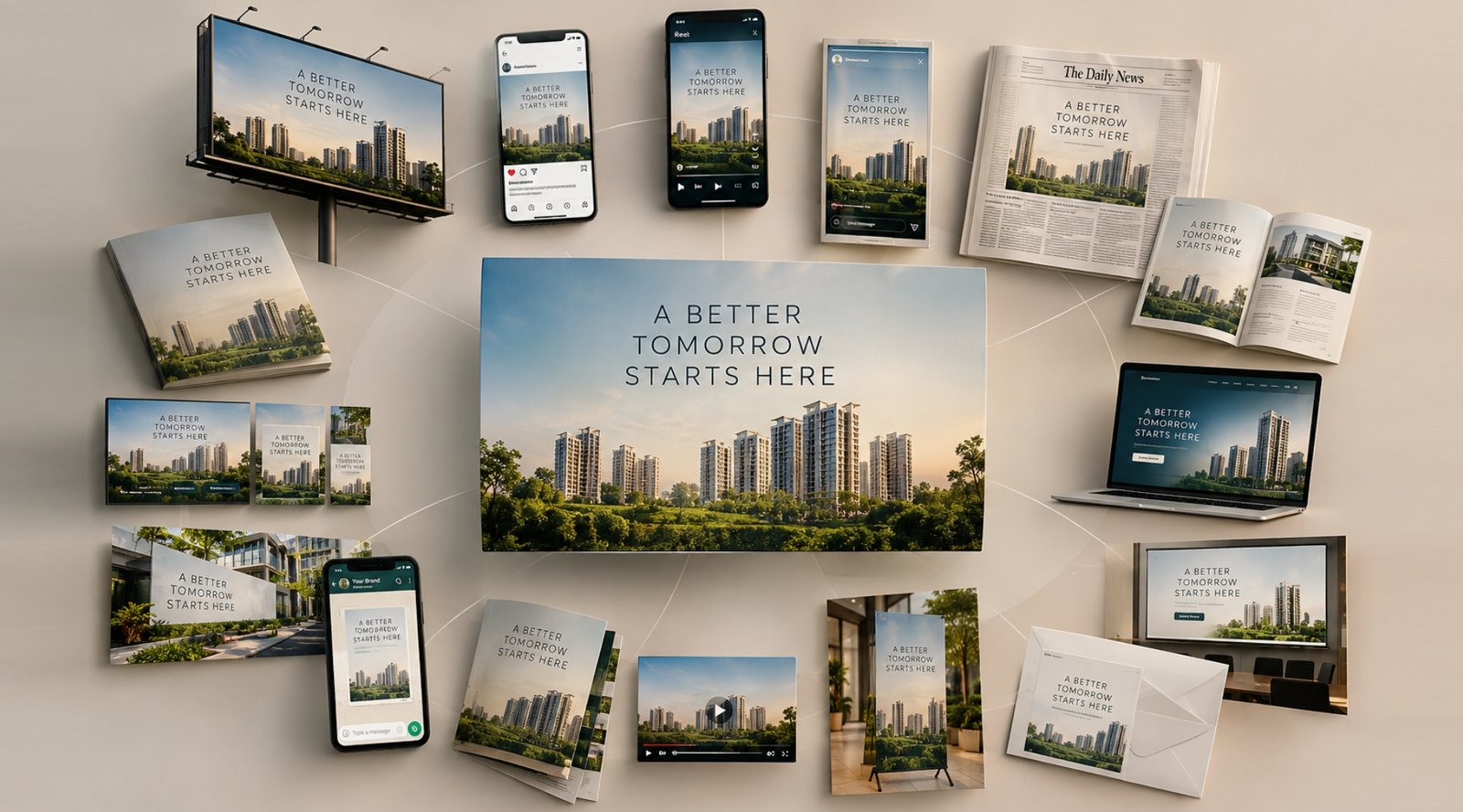
A campaign mainline has one deceptively difficult job: it has to say one thing in many different ways without losing what made it powerful in the first place.
That sounds simple until you actually have to do it.
A campaign may begin with a hoarding, move to Instagram, become a reel, appear in a newspaper, find its way onto a brochure, influence site branding, become a WhatsApp communication and eventually enter a sales conversation. Each format has a different purpose, attention span and visual language.
Yet the campaign still needs to feel like the same campaign.
That is the real test of a mainline.
A great mainline isn’t simply a clever sentence sitting on a key visual. It is the creative spine of the campaign. It gives every subsequent execution a common thought while leaving enough room for interpretation.
For a branding company in Pune, this distinction is particularly important when campaigns need to work across real estate, hospitality, retail and other sectors where a single creative thought may need to travel across dozens of touchpoints.
If an idea works only in one format, it isn’t really a campaign idea.
It’s an execution.
The Idea Has to Be Bigger Than the Headline
The strongest mainlines have a thought underneath them.
A good line doesn’t merely communicate a product benefit. It creates a territory that designers, copywriters, social teams and filmmakers can interpret in different ways.
That is what gives a campaign longevity.
Consider a real estate campaign. Saying that a project has “spacious homes”, “premium amenities” or “a great location” may communicate information, but it doesn’t necessarily create a campaign territory.
The central thought could instead revolve around what owning that home represents — aspiration, lifestyle, belonging, progress, achievement or a new chapter in life.
Suddenly, the idea has somewhere to go.
The hoarding can introduce the thought.
The reel can dramatise it.
The social media content can explore different aspects of it.
The brochure can build the story around it.
The site branding can bring it into the physical experience.
The line becomes the starting point, not the finishing point.
This is also where the difference between conventional branding and advertising companies and strategically driven creative teams becomes apparent. The objective isn’t simply to produce more creatives. It is to develop an idea that can create an entire communication system around itself.
Can It Survive Without the Original Visual?
This is one of the simplest tests for a mainline.
Take away the original artwork and ask:
Does the thought still make sense?
If yes, the idea has strength.
If the campaign depends entirely on one photograph, one layout, one celebrity, one visual trick or a particular composition, adapting it across twenty formats becomes difficult.
A strong mainline allows different visual treatments while retaining the same underlying idea.
This matters particularly in real estate, where one campaign may have to exist across dramatically different dimensions — from a massive outdoor hoarding to a vertical Instagram story.
The canvas changes.
The idea shouldn’t.
It Needs Multiple Interpretations
A campaign that runs for three months cannot keep showing the exact same communication.
The mainline needs enough depth to generate variations without becoming inconsistent.
One execution may focus on the product.
Another may focus on lifestyle.
A third may introduce an emotional narrative.
A reel may turn the thought into a story.
A tactical creative may connect the same idea to an immediate sales opportunity.
The audience should feel that the campaign is evolving — not repeating itself.
This distinction is important:
Consistency is recognisable thinking. Repetition is saying the same thing again.
The best branding agencies in Pune understand that a campaign needs a visual and verbal language capable of evolving while remaining recognisable. That is what turns a campaign into an asset rather than a collection of disconnected creatives.
The 20-Format Test
One useful way to evaluate a campaign idea is to challenge it before execution begins.
Ask the team to imagine the idea across 20 different touchpoints:
- Hoardings
- Social media posts
- Instagram reels
- Stories
- Newspaper ads
- Brochures
- Coffee table books
- Site branding
- Channel partner communication
- WhatsApp creatives
- Digital ads
- Walkthrough videos
- Sales presentations
- Email communication
- Landing pages
- Event branding
- Teasers
- Revealers
- Tactical communication
- Festival or occasion-based communication
The purpose isn’t to actually create twenty executions immediately.
The purpose is to discover whether the thought has enough creative elasticity.
If you can already imagine several distinct executions without abandoning the central idea, you probably have a campaign territory rather than a one-off creative.
For brands evaluating a branding agency in Mumbai or a creative agency in Mumbai, this scalability is an equally important consideration. A campaign shouldn’t be judged only by its first presentation. It should be evaluated by how effectively the idea can perform once it enters the real world.
Design Matters, But the Thought Comes First
A beautiful key visual can make an average idea look impressive — for a moment.
But once that campaign needs to become a reel, a six-word social post, a hoarding or a brochure cover, the weakness becomes visible.
This is why campaign thinking should happen before execution thinking.
Before designing the first key visual, ask:
- Can the idea work across formats?
- Can it generate multiple stories?
- Can the visual language evolve?
- Does the audience understand it quickly?
- Can the thought remain relevant beyond the launch phase?
- Can the sales team use the idea in conversation?
- Can the campaign accommodate tactical communication without losing its identity?
If the answer is yes, the campaign has room to travel.
For businesses searching for a branding company in Mumbai, this distinction can help separate execution-focused vendors from agencies that approach branding as a larger strategic exercise.
The Difference Between a Campaign and a Collection of Creatives
This is where many campaigns lose their impact.
A collection of individually attractive creatives is not necessarily a campaign.
A campaign has a common strategic and creative thread.
Without that thread, every post may look different, every hoarding may communicate something new and every reel may have its own idea — but the audience has nothing consistent to remember.
The strongest campaigns create memory through repetition of the thought, not repetition of the execution.
That is why a campaign mainline needs to be developed with the larger communication ecosystem in mind.
You aren’t just designing one artwork.
You’re deciding what the brand will have to say for the next several weeks or months.
Especially in Real Estate, the Mainline Has to Work Harder
Real estate campaigns have a unique challenge.
A single project can have dozens of communication requirements — location, configuration, amenities, lifestyle, pricing, connectivity, possession, offers, inventory, investment potential and more.
The mainline has to provide enough creative space for these messages without becoming diluted.
A strong central idea allows the campaign to move between emotional storytelling and rational communication.
It can create aspiration at the top of the funnel and still leave room for tactical messaging closer to conversion.
That is when a mainline becomes more than advertising.
It becomes a communication system.
And this is where the role of a branding advertising company becomes more strategic. The agency isn’t merely designing advertisements; it is helping create the framework through which the brand communicates consistently across different stages of the customer journey.
What Should You Look for in a Branding Agency?
Whether you’re exploring the best branding agency in Pune, the best branding agency in Mumbai, or one of the top branding companies in Mumbai, the same fundamental question should apply:
Can the agency develop an idea that has enough depth to grow?
A strong creative partner should be able to think beyond the first key visual and consider the campaign’s complete lifecycle — from strategy and concept to adaptation, digital communication, outdoor, content and sales support.
The objective isn’t to find an agency that simply creates attractive artwork.
It is to find a team that understands why the artwork needs to exist in the first place.
The House of Hues Perspective
At House of Hues, we look at a mainline as more than a headline on a key visual.
We ask whether the thought has enough depth to become a campaign ecosystem — across outdoor, digital, social, reels, print, brochures, site branding, sales communication and every other touchpoint where the audience encounters the brand.
Our approach is to think about scalability before execution.
Because when a campaign idea is strong enough, the formats become opportunities rather than limitations.
The hoarding doesn’t have to say exactly what the Instagram post says.
The reel doesn’t have to replicate the brochure.
The tactical communication doesn’t have to look like a resized campaign creative.
They can all have their own role while still belonging to the same creative world.
That is the kind of thinking we believe separates a campaign from a collection of creatives — and a creative partner from a production vendor.
Because the best campaign ideas don’t just look good.
They give brands more to say.
Have a campaign idea that needs to travel further?
Let’s build it.
Frequently Asked Questions
1. What is a campaign mainline?
A campaign mainline is the central creative thought that holds an entire campaign together. It goes beyond a headline and provides a foundation from which multiple executions can be developed across different media and formats.
2. Why does a mainline need to work across multiple formats?
Modern campaigns rarely exist in one medium. A single idea may need to appear on hoardings, social media, reels, brochures, digital ads, print and site branding. A scalable mainline ensures that the campaign remains recognisable while adapting naturally to each format.
3. What makes a mainline scalable?
A scalable mainline has a strong underlying thought rather than depending entirely on one visual, photograph or execution. It should allow different stories, messages and visual treatments while maintaining a consistent campaign identity.
4. How do I choose a branding agency?
Look beyond the agency’s portfolio aesthetics. Evaluate whether the team demonstrates strategic thinking, campaign scalability, understanding of your category and the ability to translate one central idea across multiple communication formats.
Whether you’re comparing the best branding agencies in Pune, a branding agency in Mumbai, or top branding companies in Mumbai, the quality of thinking behind the work is as important as the work itself.
5. What is the difference between branding and advertising?
Branding establishes how a brand is perceived, including its identity, positioning, personality and communication language. Advertising uses that foundation to communicate specific products, services, campaigns or offers to an audience. Strong agencies understand how the two work together rather than treating them as completely separate disciplines.
6. Can one mainline accommodate tactical communication?
Yes. A well-developed mainline can provide a creative framework for tactical communication without making every execution look identical. This allows the campaign to remain consistent while responding to changing market and sales requirements.
7. Can House of Hues develop a complete mainline campaign?
Yes. House of Hues approaches mainline campaigns as broader communication ecosystems, covering the central creative thought and its application across outdoor, digital, social, print, brochures, site branding and other relevant brand touchpoints.
If you’re looking for a creative agency in Mumbai or a strategic creative partner in Pune to develop a campaign idea that can travel across formats, the starting point is always the same: build the thought before building the artwork.
House of Hues is where strategy, storytelling and standout creativity come together. We help brands build personalities people connect with and identities they remember.
You may also like

Graphic Design Services in Pune: Professional Designs for Modern Businesses

How to Choose the Right Branding Agency for Your Business in Pune

How Professional Graphic Design & Printing Builds a Strong Business Identity

Brand Identity vs Brand Image: A Beginner’s Guide to Building a Strong Brand