




Great design can’t fix bad brand positioning because design only changes how a brand looks, while positioning decides what it means and why customers should choose it. A clear brand positioning strategy defines the audience, the difference and the proof behind the promise. Without it, even a polished logo, website or campaign blends in with competitors.
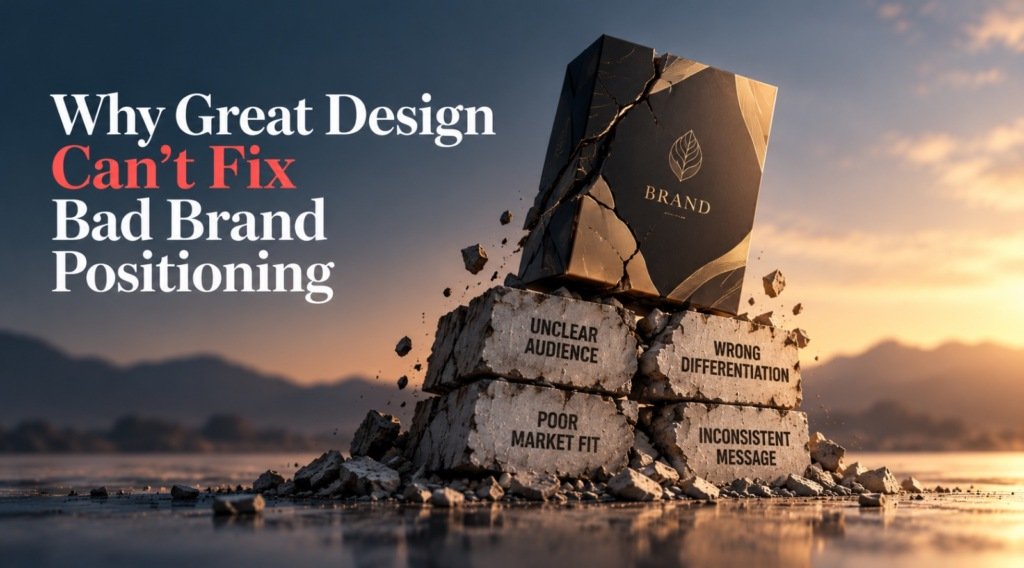
A brand can have a beautiful logo.
A sophisticated website.
Professional photography.
Elegant typography.
A social media feed that looks like it belongs in a design magazine.
And still struggle to explain why anyone should choose it.
When a potential customer compares your brand with three others offering something similar, what makes them choose you? Is it simply because your brand looks better, or is there a more compelling reason?
The problem may not be the design. It may be what the brand is trying to communicate in the first place.
Because design can make a brand look different. Positioning makes it mean something different.
And confusing the two can become an expensive mistake.
Design Makes You Noticeable. Positioning Makes You Relevant.
Design is often the most visible part of branding, so it naturally gets a lot of attention.
Businesses spend time choosing colours, exploring typography, refining logos, commissioning photography and building websites. These decisions matter because they shape the first impression a customer forms.
But a first impression is only the beginning.
What happens when a customer compares your brand with three others? If all four brands look professional, use similar language and make similar promises, visual appeal alone may not be enough to influence the decision.
A strong brand positioning strategy starts with a different set of questions.
Who are we trying to attract? What do these customers genuinely value? Which problem are we solving particularly well? What makes our approach different? And what do we want people to remember about us when they are ready to make a decision?
These questions establish the direction for everything that follows.
Without clear answers, design can become an exercise in making a brand look better without making it any easier to understand.
What Happens When Positioning Comes After Design?
We have all seen brands that look impressive but struggle to communicate a clear point of view.
The logo is polished. The website feels expensive. The communication uses all the right words: premium, innovative, trusted, exceptional.
Yet nothing feels particularly distinctive.
This often happens when creative decisions are made before the business has established what it wants to stand for.
The process begins with references. Someone likes the colours used by an international brand. Someone else wants a more luxurious website. Another stakeholder asks for something modern and minimal.
Soon, the team is debating aesthetics without agreeing on the underlying idea.
Should the brand feel premium or approachable? Is it speaking to a first-time buyer or an experienced investor? Is its biggest strength design, convenience, service, expertise or a specific customer experience?
These are not questions a new logo can answer.
A considered brand strategy for businesses brings clarity to these decisions before they become expensive creative exercises. It connects business objectives, audience expectations and the competitive environment to a clear brand proposition.
Once that foundation is in place, design has a purpose beyond looking good.
Consider Two Real Estate Projects With the Same Problem
Take two residential projects in Pune.
Both offer spacious apartments, landscaped amenities, a clubhouse, attractive architecture and a well-connected location. Both have invested in professional photography and high-quality marketing materials.
Now imagine that both projects communicate the same message: Experience luxury living.
The communication may look different, but the underlying promise is almost identical.
One project could be particularly suited to families who value privacy, generous living spaces and a sense of community. The other might appeal to professionals who prioritise contemporary architecture, convenience and a more connected urban lifestyle.
Neither proposition is inherently better. What matters is that each gives the right buyer a clearer reason to consider it.
This is the difference between marketing a list of features and building a distinctive position in the market.
Effective brand positioning for real estate goes beyond describing the apartment, the amenities or the neighbourhood. It identifies the value those features represent to a particular audience and turns that value into a consistent story.
That story should influence the project’s identity, campaign communication, website, brochures, sales presentation and even the way the sales team explains the offering.
When the positioning is clear, the brand stops trying to appeal to everyone in the same way.
It starts becoming more relevant to the people most likely to connect with it.
Brand Positioning Is Not Just About Being Different
There is a common misconception that a brand needs to say something nobody else has ever said.
In practice, that is rarely the real challenge.
Most businesses operate in competitive categories where products, services and customer expectations overlap. Real estate is a good example. Developers may offer comparable configurations, amenities, specifications and location advantages.
The challenge is not necessarily to invent a completely new category. It is to identify a meaningful difference and communicate it in a way customers can understand and believe.
A useful positioning statement should make three things clear:
- Relevance: Why should the intended audience care?
- Difference: What makes this brand a more compelling choice?
- Credibility: What evidence supports the promise being made?
If a brand claims to offer an exceptional customer experience, the experience itself must support that claim. If a developer promises thoughtful design, the architecture, planning and communication should reinforce it.
Positioning is not a clever tagline. It is a strategic decision about the space a brand wants to occupy in the customer’s mind.
The tagline, visual identity and campaign are ways of expressing that decision.
Why Luxury Brands Need More Than a Premium Look
The distinction becomes even more important in the luxury segment.
A black-and-gold colour palette, elegant typography, dramatic photography and minimal layouts can all create a premium visual impression. But these are visual conventions, and competitors can adopt them just as easily.
For luxury real estate brand positioning, the more important question is what luxury actually means to the intended buyer.
For one audience, it might mean privacy, exclusivity and a sense of separation from the everyday. For another, it could mean architectural distinction, a prestigious address, exceptional service or the freedom to personalise a living space.
These are very different propositions, even if both projects fall within the luxury category.
A developer that understands its audience can build a more convincing brand narrative around the things its buyers genuinely value. The design then supports that narrative through the choice of imagery, language, materials, visual restraint and overall experience.
This does not mean every luxury brand needs to be understated or minimalist. It means the creative direction should emerge from the brand’s positioning rather than from a generic idea of what luxury is supposed to look like.
For developers investing in branding for real estate developers, this distinction can help create a more coherent identity across projects, while allowing each development to communicate its own audience, character and value proposition.
A Strong Brand Strategy Makes Creative Decisions Easier
One of the practical benefits of getting positioning right is that it reduces unnecessary debate.
When the strategic direction is unclear, creative reviews tend to revolve around personal preferences.
“Can we make this more premium?”
“Can the colours be more vibrant?”
“Can we make it look more international?”
There is nothing wrong with these questions, but they need context.
If the brand is built around trust and long-term relationships, a particular visual direction may reinforce that idea. If it is positioned around youthful energy and accessibility, an entirely different approach might be more appropriate.
The question is no longer whether a design looks good in isolation. It is whether it communicates the intended brand idea effectively.
This is where brand strategy and creative execution become closely connected.
Positioning establishes the direction. Brand storytelling gives the idea a voice. Visual identity gives it a recognisable form. Marketing brings it to the right audience through relevant channels.
Together, these elements create a more consistent experience, from the first advertisement a customer sees to the conversation they have with the sales team.
And consistency matters because brands are not built through a single creative. They are built through repeated experiences that reinforce the same underlying promise.
From Positioning to Marketing Strategy for Business Growth
Branding is sometimes treated as a one-time exercise: develop a logo, create a website, prepare a brand book and move on to marketing.
But a brand is not finished when the identity is delivered.
Its positioning needs to inform how the business communicates, competes and grows.
A clear proposition can help a company prioritise the audiences it wants to reach, sharpen its messaging, create more relevant campaigns and build recognition over time. It can also give internal teams a shared understanding of what the brand should and should not represent.
This is particularly useful when a business is expanding into new markets, introducing new offerings or trying to move beyond price-led competition.
For example, a company seeking a Brand Positioning Strategy in Pune may need to establish a stronger local identity in a crowded market. A business looking for a Brand Positioning Strategy in Mumbai may face a different competitive landscape, audience expectation or category perception.
The fundamentals remain the same, but the research, customer insights and strategic choices must reflect the market in which the brand operates.
This is also why marketing strategy for business growth should not be separated entirely from brand strategy. Marketing can generate attention and demand, but a clear brand proposition helps determine what that attention should lead people to understand, value and remember.
A campaign may create a spike in enquiries. A well-positioned brand gives customers a more consistent reason to choose the business beyond that individual campaign.
What Should a Business Do Before Investing in a New Identity?
Before redesigning a logo or rebuilding a website, it is worth stepping back and examining the brand itself.
Start with a few honest questions.
- Can we explain what makes us different in one or two sentences?
If the answer relies entirely on words such as quality, trust, innovation or premium service, the proposition may need more thought.
- Do we understand the audience we are trying to attract?
A brand cannot be equally relevant to everyone. Knowing who matters most helps determine which benefits, messages and experiences deserve emphasis.
- Does our communication reflect how customers actually make decisions?
Businesses often talk about what they want to sell. Effective positioning also considers what customers want to achieve, avoid or feel confident about.
- Is our brand promise supported by the actual experience?
The website, sales process, customer service and product must reinforce the same idea. Otherwise, the communication creates expectations the business cannot fulfil.
- Are our design and marketing decisions guided by a common strategy?
If every campaign feels like it belongs to a different brand, the problem may be a lack of strategic consistency rather than a lack of creative ideas.
Answering these questions gives a redesign a stronger starting point and helps ensure that the investment addresses the real problem.
Why the Right Brand Strategy Agency Matters
A good branding partner should do more than produce a visually appealing identity. It should help the business understand what it needs to communicate, whom it needs to reach and how it can establish a meaningful position in its category.
For businesses evaluating a Brand Strategy Agency in Pune or a Brand Strategy Agency in Mumbai, the important consideration is not just the agency’s portfolio. Look at how it approaches discovery, competitive analysis, audience understanding, brand architecture, positioning and the translation of strategy into creative work.
The right partner will challenge assumptions where necessary, ask uncomfortable questions when the brief is unclear and connect creative decisions to business objectives.
For real estate developers, this becomes especially relevant when a project needs to stand out in a market where competing developments may share similar specifications and amenities. The agency needs to understand not only branding but also buyer motivations, project differentiation and the relationship between brand communication and the sales journey.
At House of Hues, we see strategy and design as parts of the same process, not separate services that happen to meet at the end.
The aim is to create brands that are not only visually considered but also clear about what they stand for and why the right audience should care.
Great Design Starts With a Clear Idea
A beautiful identity can make people stop scrolling. A well-designed website can make a strong first impression. A thoughtfully executed campaign can attract attention.
But none of these can permanently compensate for a brand that has not worked out what makes it worth choosing.
The strongest brands begin with clarity. They understand their audience, know the space they want to occupy and have a credible reason for being different.
Design then becomes more than decoration. It becomes a way to make that difference visible, recognisable and memorable.
At House of Hues, we believe the real work begins before the first colour palette or design reference. It begins with understanding what the brand needs to mean to the people it wants to reach.
Because the goal is not simply to make a brand look premium.
It is to build a brand that gives people a reason to choose it.
If your business has invested in design and marketing but still struggles to communicate what makes it different, it may be time to revisit the positioning behind the brand.
House of Hues helps businesses and real estate developers bring greater clarity to their brand strategy, positioning and creative communication.
Frequently Asked Questions (FAQs)
1. What is brand positioning, and why does it matter for a business?
Brand positioning is the process of defining how a business wants to be perceived by its target audience compared to competitors. It identifies what makes the brand relevant, different and worth choosing. A clear brand positioning strategy helps businesses communicate consistently, attract the right customers and build long-term brand recognition.
2. What is the difference between brand identity and brand positioning?
Brand positioning defines what a brand stands for, whom it serves and why it is different. Brand identity is how that positioning is expressed through visual and verbal elements such as the logo, colours, typography, imagery, tone of voice and messaging. Strong brand identity and positioning work together to create a recognisable and meaningful brand.
3. Why is brand positioning important for real estate developers?
Brand positioning for real estate helps developers differentiate their projects in competitive markets where multiple developments may offer similar configurations, amenities and location advantages. A well-defined positioning strategy identifies the project’s distinctive value proposition and translates it into consistent communication across advertising, brochures, digital campaigns and the sales experience.
4. How do I choose the right brand strategy agency in Pune or Mumbai?
Look for a brand strategy agency that understands your business, target audience, competitive landscape and growth objectives. Beyond its creative portfolio, assess how the agency approaches research, positioning, brand messaging and implementation. For real estate businesses, relevant industry experience and an understanding of buyer behaviour can be particularly valuable.
5. How does brand strategy contribute to business growth?
A well-defined brand strategy helps a business communicate its value more clearly, establish differentiation and build trust with its target audience. When aligned with marketing, it can improve campaign consistency, support customer acquisition and strengthen brand recall. It does not guarantee sales on its own, but it gives marketing and creative efforts a clearer strategic direction.

House of Hues is where strategy, storytelling and standout creativity come together. We help brands build personalities people connect with and identities they remember.
You may also like

The Difference Between Content That Gets Views and Content That Gets Remembered

Can PR Build Brand Equity Better Than Advertising?

Celebrity Endorsement for Real Estate: When Does It Make Strategic Sense?

Influencer Marketing for Real Estate: What Can a Creator Actually Sell?